This is as strange a maze as e’er men trod
And there is in this business more than nature
was ever conduct of…..
(from The Tempest, by William Shakespeare)
Although the words “maze” and “labyrinth” nowadays tend to be used as synonyms, “labyrinth” refers to a construction or design which is unicursal – that is, having one path without junctions or dead ends. To solve a labyrinth involves simply following a single path through its convolutions from beginning to end. A maze is multicursal; in its design, the original path branches or forms junctions with others, so that its ‘solution” relies on some trial and error. It should be noted that English is the only language with two words to distinguish this difference.
The earliest public labyrinths, appearing in medieval Europe, were large scale designs set into the floors of the great cathedrals. Made of contrasting slabs of stone or marble, they were generally circular in shape, structured around a central cross. Commonly formed of 7 or 11 rings, these figures represented the circuitous path of the human soul as it rose and fell in the journey towards the ultimate goal of salvation. Some have also theorized that the rings of paths around the usually circular “goal” represent the nimbus of light behind the head of the Christ figure. Such labyrinths were not considered as a means of pleasure, but of penitence; did not walk labyrinths but were to complete them on their knees as a means of atonement. Given the size of many of these labyrinths – that at Chartres is 40 feet in diameter, requiring a journey of 150 yards to complete - the suffering must have been considerable!
The religious fervor of masinnersinland Europe which culminated in the construction of the great medieval church labyrinths does not seem to have caught on in England. In fact, the only known medieval example of an English ecclesiastical labyrinth is a roof boss in the north aisle of St. Mary Redcliffe Church, Bristol, only 4” in diameter. The English preferred paths of turf, cut or trod into the village green, and used these architectural figures for pleasure rather than penitence. Nearly 200 of these labyrinths are known to have existed, mainly in the south of England. Their connection with spring “merry making” or May festivals suggest a link with the pagan fertility rites of old. Certainly, the pattern of intertwining paths bear a strong resemblance to the mathematical progression of dancers round a maypole (the use of which continued long after most of the turf labyrinths had ceased to exist). In A Midsummer Night’s Dream, the result of the bad weather caused by the disharmony between Oberon and Titania leads the latter to remark that “....the quaint mazes in the wanton green/for lack of tread are undistinguishable.”
With the Renaissance, unicursal labyrinths of turf gradually made way for hedge labyrinths (quite when or why the change occurred has not been ascertained). These became features in gardens of the leisured upper echelons of society. The puzzle aspect of a maze seems to have first developed during this time. Perhaps there are links here with the over-and-under patterns of the knot garden and the open parterre’s network of paths; certainly, the first recorded examples of hedge mazes are from 15th century France and Italy, both countries with strong traditions of both parterres and knot gardens.
Pleasure garden with a maze
Originally, these labyrinths and mazes seem to have been no more than knee high, composed of dwarf forms of shrubs such as box or shrubby herbs like hyssop. As with the parterre sections, the paths would have been of coloured sands or gravels, or simply beaten or trodden earth. In a painting after Tintoretto, now in the Royal Collection, the hedges appear to be low trellises on which shrubby climbing plants have been trained. Although this painting depicts an imaginary location, we can reasonably suppose that the horticultural methods it depicts are based on the gardening practices of the time.
It became established practice in grander mazes to add a further element of confusion by growing the hedges to above eye level; placing statues, fountains, seats or decorative objects such as urns or flower beds, to be encountered as the route was negotiated, added interest. In some mazes, the puzzle was further complicated by rules that these garden features had to be visited in a specific order; this guidance introduced moral or allegorical themes, making mazes instructional as well as merely pleasurable.
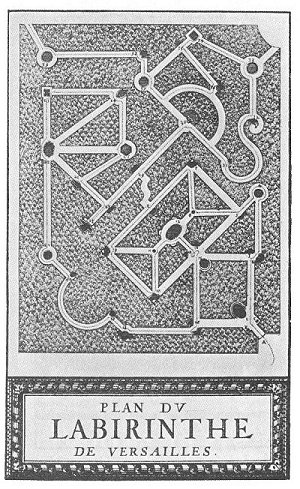
Mazes of this kind reached a climax of extravagance – as did many other horticultural practices – in the grounds of Versailles. At the intersections of avenues formed of pleached limes or hornbeams, with rolled gravel paths underfoot, were a complex sequence of 39 statues representing some of the fables of Aesop.
Many of these statue groups were also fountains, and each was accompanied by an engraved plate retelling the fable and drawing a suitable moral conclusion. The entrance to the maze was guarded by figures of Aesop and Cupid, the latter holding a ball of golden thread leading to the first intersection (in itself an allusion to the famous Cretan labyrinth of Knossos, home of the Minotaur,). Suitably, given Cupid’s role as the attendant of Venus, Goddess of Love, courting couples in search of privacy made much use of this maze. Alas, it no longer exists, but a statue of Ariadne marks its location.
Ground-level view of the maze at Hampton Court